
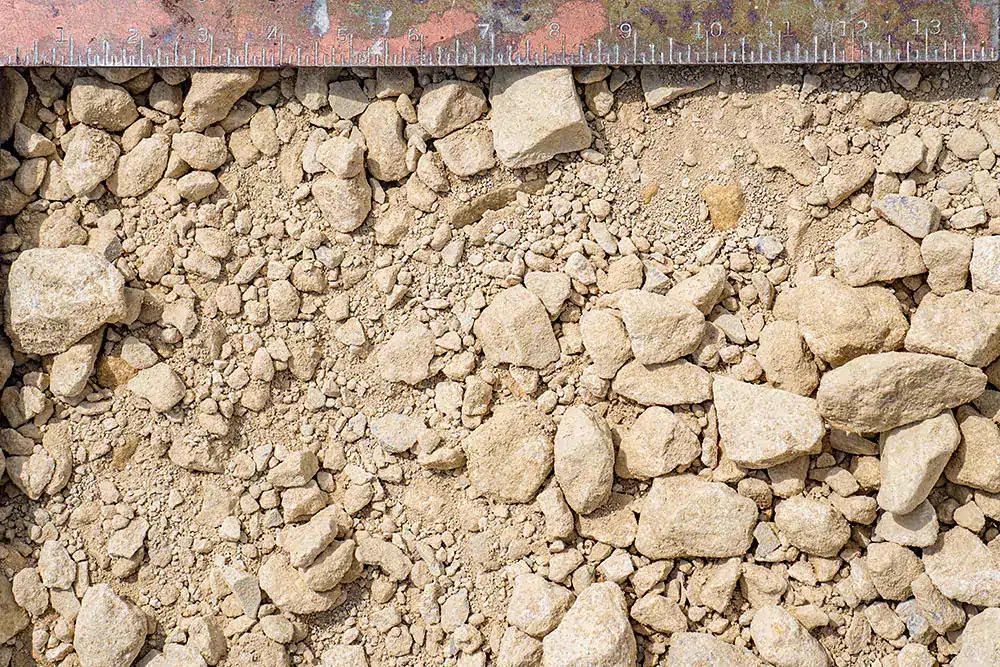
Road base is the compacted layer of crushed aggregate that sits under a driveway, sidewalk, slab or road and carries the weight above it. It is usually crushed stone or crushed concrete with fine particles mixed in so it packs tight. In Naples, RM Naples sells 4.0 inch mixed base rock made from recycled concrete for $20 per cubic yard.
If you searched for road base because a contractor or a supplier used the word and you nodded along, you are in good company. The term gets used for a material, a layer and a job, often in the same sentence. This guide separates those three, explains how road base differs from the gravel you see in a landscaping bed, and covers what is worth knowing before you order a load in Southwest Florida.
What is road base?
Road base is the layer of compacted crushed aggregate placed on prepared ground before the final surface goes on. Its job is to spread load over the soil below, stay stable when wet, and give a flat, firm platform for asphalt, concrete, pavers or a finer wearing course of stone.
The key word is layer. Road base describes where the material goes and what it does, not one specific rock. That is why two suppliers can sell very different products under the same name, and why asking for “road base” without a size or a material gets you a guess.
What is road base made of?
Road base is usually made from crushed stone, crushed concrete or reclaimed asphalt, blended so that large pieces and fine particles sit together. The fines fill the gaps between the bigger pieces, which is what lets the layer lock up solid when it is compacted instead of staying loose like a pile of marbles.
Recycled concrete is a common choice in Florida. Florida’s DOT says its current specifications allow crushed concrete from an existing concrete pavement to be recycled into a new pavement as base or aggregate material, and also allow crushed concrete from general construction and demolition waste when the source has been approved. The same page is honest about the catch: crushed concrete varies depending on where it originates and how it is processed. That is the practical argument for buying from a facility that screens and grades what it sells, rather than from a pile of mixed rubble.
RM Naples makes its crushed concrete from demolished structures, the same material described in our guide to concrete disposal and rebar drop-off in Naples. For how each grade is used, start with the crushed concrete size guide.
Is road base the same as gravel?
No. Gravel is a type of loose rock, often rounded, and can be any size. Road base is a graded mix of angular pieces and fines made to compact into a firm layer. Pea gravel and river rock look tidy but roll under tires. Road base locks together, which is why it goes under the surface instead of on top.
This is the single most common mix-up on a driveway job. Rounded stone has nothing to grip its neighbors, so it migrates to the edges and leaves ruts. Angular, mixed-size material packs down. Our gravel driveway guide walks through the layers, and the drainage rock guide explains the opposite case, where you want clean stone with no fines because the goal is to let water through.
Base rock, crusher run and limerock: same thing or not?
Not always. The names get used loosely from one region to the next. Base rock is the label RM Naples uses for its 4.0 inch mixed product. Crusher run is a common name elsewhere for crushed stone with its fines left in. Limerock is a quarried Florida limestone product. All are meant to be base layers, but they are different materials.
Because the nicknames overlap, the safe way to order is to ask for two things: the material (crushed concrete or quarried stone) and the top size (4.0 inch, 3/4 inch, 1/4 inch). A name alone does not tell you either. If a supplier cannot tell you what is in the pile, that is useful information too.
What is road base used for?
Road base goes under anything that needs a firm, level, free-draining platform. RM Naples lists its 4.0 inch mixed base rock for road base, sidewalks, driveways and foundations. It is also the usual layer under pavers and slabs, and the compacted foundation for a gravel drive.
For a road base for a driveway, the pattern is a thick compacted base of the coarser mix, then a thinner wearing course of a finer grade such as 3/4 minus or 1/4 minus on top. Under pavers, the base is thinner and the choice of grade matters more, which is covered in the crushed concrete size guide.
Road base on Naples sand
Naples sits on sand, and sand does not hold a shape the way clay does. A base layer spreads the load, but it can only be as good as the ground under it, so the sand needs to be firm and dry before any rock goes down, and each layer needs compacting before the next.
That is why timing matters here. A base placed during a heavy wet-season stretch can wash and shift before it sets. Wait for a few dry days, compact the exposed sand, then place and compact the base in layers. Our gravel driveway guide covers depths and the subgrade step in detail, and the yard leveling guide covers what to do if the ground has low spots to fix first.
How much does road base cost in Naples?
RM Naples prices base rock by the cubic yard. The 4.0 inch mixed base rock is $20 per cubic yard, the lowest of its graded crushed concrete products. Finer grades cost more: $25 for 1/4 minus and for 1.5 minus, $30 for 3/4 minus. Prices were checked on the product pages on 5 November 2026.
| Grade | Price per cubic yard | Typical job |
|---|---|---|
| 4.0 inch mixed base rock | $20 | Road base, sidewalks, driveways, foundations |
| 1/4 minus | $25 | Fine wearing course |
| 1.5 minus | $25 | Ask the yard which jobs suit it |
| 1.5 to 4 inch rock | $25 | Drainage, landscaping, fill |
| 3/4 minus | $30 | Wearing course over a base |
You may see road base quoted per ton elsewhere. RM Naples sells by the yard and has not published a weight per yard for its products, so a per-ton price from another yard is not directly comparable. Our cubic yard weight guide explains why, and how to plan a load your truck can legally carry.
Picking up road base in Naples
You order and collect at the facility at 195 Basik Drive, Naples, FL 34114. Enter via Basik Drive, stop at the call station so the office can open the gate, order and pay at the office, then get loaded. Call 239-452-2839 to confirm a grade is in stock before you drive over.
Stock changes with production, so a quick call saves a wasted trip. If you are still working out quantities, the bulk material overview lists every crushed concrete grade, and the contact page is the place to send your measurements for a quote. You can also see everything on the shop page, or read more about the facility.
Frequently asked questions
Is road base the same as gravel?
No. Gravel is a type of loose rock, often rounded, and can be any size. Road base is a graded mix of angular pieces and fines made to compact into a firm layer.
Is road base cheaper than gravel?
It depends on the material and the supplier, so compare per cubic yard rather than by name. At RM Naples, the 4.0 inch mixed base rock is $20 per cubic yard, the lowest price among its graded crushed concrete products.
How much is a ton of road base?
RM Naples sells by the cubic yard, not by the ton, and has not published a weight per yard. For planning a load, use the weight guide and call for a quote on your quantity.
What is road base good for?
It makes a firm, level platform under driveways, sidewalks, slabs, pavers and foundations. RM Naples lists its 4.0 inch mixed base rock for road base, sidewalks, driveways and foundations.