
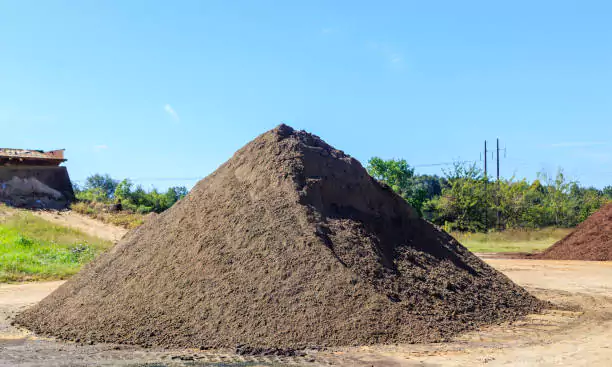
Screened topsoil is topsoil that has been passed through a mesh screen to remove sticks, stones, roots and clumps, leaving a fine, even texture that is easy to spread and plant into. In Naples, where native ground is mostly sand, the phrase can mean something different from what a northern guide describes, so it pays to ask what a supplier’s topsoil is actually made of.
Most online answers to this question were written for yards with clay or loam under them. Southwest Florida is different, and so is the soil that gets sold here. Below you will find what screening does, how screened and unscreened soil compare, what is in the organic topsoil RM Naples sells, and when screened topsoil is the wrong tool for the job.
What is screened topsoil?
Screened topsoil is soil or soil-like material that has been run through a screen, which holds back the large pieces and lets the fine material fall through. The result is uniform, crumbly and free of debris. It spreads evenly, mixes easily into a bed and gives seed or sod a smooth surface to settle into.
Screening is a physical step, not a recipe. The screen tells you the particle size, not what the material is. Two piles can both be “screened topsoil” and be completely different underneath, one mostly sand, another mostly composted plant matter. That is why the first question to ask any yard is what the product is made from.
Screened vs unscreened topsoil: what is the difference?
Unscreened topsoil is sold as dug or mixed, with whatever pieces came with it. Screened topsoil has had the oversize material removed. Screened costs a little more per yard because of the extra processing, but it saves time raking out debris and gives a more even result for lawns, beds and planting.
| Unscreened | Screened | |
|---|---|---|
| Texture | Lumpy, mixed sizes | Fine, even |
| May contain | Sticks, stones, roots, clods | Little or none of the oversize pieces |
| Spreads | Unevenly, needs raking out | Evenly, ready to level |
| Best for | Rough fill, large low areas | Lawn top dressing, beds, planting |
Neither is better in the abstract. If you are filling a deep hole, unscreened material is fine and often cheaper. If you are building a planting bed or preparing ground for grass, screened is worth it. The two guides that cover the wider soil question are our garden soil mix guide and our comparison of mulch, compost and topsoil.
Why topsoil means something different in Naples
Because Florida ground is mostly sand. UF/IFAS Extension notes that the majority of Florida’s soils are sandy-based, with little organic matter and low water- and nutrient-holding capacities. In a place like that, there is rarely a thick layer of dark native topsoil to dig up and screen, so topsoil sold here is often a made product.
That changes what you are buying. A northern “screened loam” is real soil with clay and silt in it. Screened topsoil in Naples may be sand, may be a sand and compost blend, or may be almost entirely composted organic matter. All of those can be useful, but they behave differently. A mostly organic product holds water and nutrients far better than sand does, but it also breaks down over time and settles. Ask what is in the pile before you work out how much to order.
What is RM Naples’ organic topsoil made from?
RM Naples makes its organic topsoil from yard waste: finely screened compost and leaf mold, blended into a nutrient-rich, balanced mix. It is a made product, not dug native soil, and it sells for $25 per cubic yard. It is screened, and it is based on organic matter, not on sand or clay.
That matters for how you use it. The same UF/IFAS fact sheet describes composted yard waste as having good water-holding capacity and a moderate decomposition rate, which is why compost-based material suits Florida’s fast-draining sand. The flip side is that organic material is consumed by soil life over time. If you want to know how much to apply and when, our compost for lawns guide covers rate and timing for established grass. Check the product page for current stock, because availability changes.
Is screened topsoil good for grass?
Screened topsoil is a good surface for starting or repairing grass, because it is fine, free of debris and holds moisture around seed and roots. For an existing lawn, a thin top dressing works. For a new lawn on Naples sand, mixing compost-based material into the ground works better than burying sand under a layer of it.
The fact sheet’s guidance for a new Florida lawn is to mix organic amendment into the top 6 inches of soil, not to stack it on top as a separate layer. We cover the quantities in our top dressing and compost guide and the depth maths in the yard leveling guide. If you are comparing amendments, the mulch versus compost guide explains what each one is for.
When screened topsoil is the wrong choice
It is the wrong choice for raising a low area by more than a few inches, and for any job where you need a firm base. Organic-based topsoil settles as it decomposes and does not compact solid, so deep fill should be a mineral material. RM Naples does not sell fill dirt, so ask the yard or a contractor for that.
Two common mistakes are worth avoiding. The first is using topsoil to fix a drainage problem, which it will not do on its own: if water pools, look at the drainage rock guide first. The second is using it as mulch. Topsoil feeds a bed, mulch covers and protects it, and the two are not interchangeable. If you are unsure which one the job needs, the cubic yard weight guide also helps you plan how to haul whichever you pick.
Buying screened topsoil in Naples
Order and collect at 195 Basik Drive, Naples, FL 34114. Enter via Basik Drive, stop at the call station so the office can open the gate, order and pay at the office, then get loaded. Call 239-452-2839 first, because organic topsoil stock moves and the product page can show it as unavailable.
You can see current pricing on the mulch, compost and topsoil page and the shop, compare it with compost at $15 per cubic yard, or send your area and depth through the contact page for help with a quantity. You can also read more about the facility.
Frequently asked questions
What is the difference between screened topsoil and regular topsoil?
Screened topsoil has been passed through a mesh to remove sticks, stones and clumps, so it is fine and even. Regular, unscreened topsoil is sold as dug or mixed and may need raking out before you plant.
Is screened topsoil good for grass?
Yes, as a surface for seed and as a thin top dressing on an existing lawn. For a new lawn on sandy ground, UF/IFAS guidance is to mix organic material into the top 6 inches rather than lay it on top.
How much does a yard of screened topsoil cost?
RM Naples sells its organic topsoil at $25 per cubic yard, checked on the product page on 5 November 2026. Call to confirm current stock and ask about delivery for your quantity.
Can I top dress my lawn with topsoil?
Yes, in a thin layer that the grass can grow up through. Spread it evenly, rake it level and water it in. See the compost for lawn guide for how thin and how often.